The photosheet is dead. Long live the photosheet.

Every OOH operator has a folder of photosheets. Most of them have several.
You know the ones. A one-page PDF for each board on the network. Photo of the structure in the upper left. Specs across the top: dimensions, illumination, build date, lat-long. Impressions from a study someone commissioned in 2017. A small map graphic showing the board's position relative to a freeway exit. And then — in the bottom third of the page, in slightly-too-small font — the talking points.
Excellent visibility from northbound traffic. Reaches commuters traveling from the suburbs into the central business district. High-income demographic. Strong fit for retail, automotive, and quick-service restaurants.
Nobody who works at the operator remembers who wrote those talking points. The file metadata says they were created in 2019 by someone whose name doesn't appear on the current org chart. Several of them describe nearby businesses that have since closed. One of them refers to a stadium the city tore down four years ago. The "high-income demographic" claim was made before the new apartment complex went up across the street and shifted the trade area's median income by twenty thousand dollars.
The photosheets are stale. The rep using them knows they're stale. The rep using them is using them anyway, because what's the alternative.
This piece is about the alternative.
What the photosheet was supposed to be
The photosheet, as an artifact, made sense in the world it was created for.
That world looked like this: an advertiser called the operator. The rep took the call. The rep needed to leave-behind something that proved the board existed, looked good, and was worth the money. Print the photosheet, fax the photosheet, eventually email the photosheet as a PDF. The advertiser glanced at it, filed it, and either called back or didn't.
In that world, the photosheet was a static artifact for a static conversation. The board didn't change. The talking points didn't need to change. The pitch was: here is what we have, here is roughly what it's near, here is the rate.
That world is gone.
The advertiser today is not asking what do you have. They are asking what is this specific board, for my specific business, this specific quarter. If you answer that question by emailing them a 2019 PDF with the rate handwritten in the margin, the conversation ends before the discount is even negotiated. Not because your board is wrong for them — it might be perfect for them — but because the artifact you sent told them you don't actually know what your board is.
The photosheet was infrastructure for a 1995 sales motion that operators have been running on autopilot for thirty years. The motion stopped working somewhere around 2018. The infrastructure is still in the folder.
What a board actually is, when you stop treating it as a poster
A board is not a static object. It is a position in a system that moves around it.
Take any single board on any operator's network. Stand in front of it. Look at what's actually there. The trade area shifted demographically in the last five years. The retail context changed — a Target opened two miles east, the regional mall lost its anchor tenant, the highway exit pattern got re-engineered when the new bypass went in. The audience flowing past changed because the route function changed — what used to be commuter traffic is now mixed commuter and event traffic because the arena opened. The seasonal pattern is different from what the 2019 photosheet captured because the local festival circuit doubled and the high school district consolidated.
The board didn't move. Everything around it did.
Now layer on what's happening to the brands and verticals that historically buy in this kind of context. QSR is in a discount-cycle pull because grocery inflation flipped consumer behavior. Auto is sitting on the highest inventory levels since 2008. Healthcare systems in the region are in active competitive expansion. The state tourism board just got a budget increase and is shopping for OOH in this exact corridor. Three regional banks are positioning for an M&A cycle and are about to spend on awareness.
None of that is in the photosheet. None of it can be. The photosheet was written once, by one person, against a snapshot of a market that has since moved on without it.
The board's real talking points — the ones that would actually win a pitch today — change every week. They are a function of who the board is for, this quarter, given everything happening around it. They are written for the specific vertical the rep is calling. They are sharpened further for the specific brand inside that vertical, given what that brand is currently doing.
A rep who has access to those talking points walks into a different conversation than the rep who has the photosheet.
Three layers of pitch the photosheet was never going to produce
When you stop treating a board as a poster and start treating it as a position in a system, the pitch decomposes into three layers — each one more specific than the last, each one impossible for a static document to capture.
The board layer. Why this specific board matters, framed against what's actually true about its corridor, audience, traffic patterns, seasonal density, format advantages, and contextual relevance — right now. Not in 2019. Not in averages. Now.
For a digital bulletin on the US-2 / MN-71 corridor in Cass Lake, the board layer talks about its position as a gateway to the Leech Lake region, its 9,800 daily impressions skewing toward resort travelers and seasonal cabin owners, the seasonal traffic surge from May through September during peak fishing and resort season, the ice fishing and snowmobile audience from December through March, the contextual proximity to Bemidji State University. Each of those is a defensible, specific, current claim about what makes that board what it is. None of them are in any photosheet anywhere.

The vertical layer. Why this board, for this category of advertiser. Same board, different lens. Each vertical has different audience requirements, different seasonal patterns, different messaging windows. A board that scores high for QSR scores differently for healthcare, differently again for tourism, differently for B2B. The pitch should reflect that.
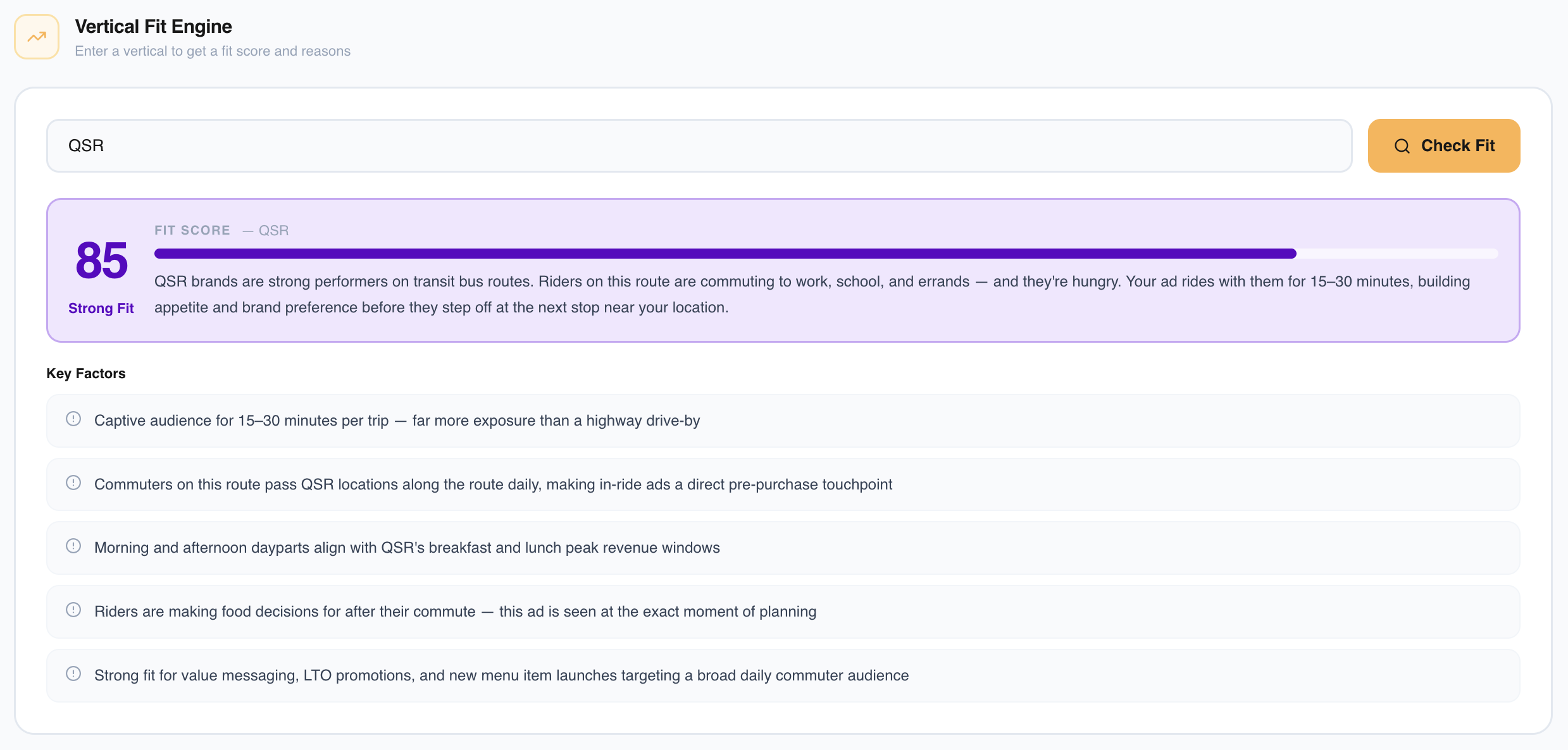
For the same Cass Lake board scored against QSR, the vertical layer talks about the captive 15-30-minute exposure window, the audience's commuter overlap with QSR locations along the route, the morning and afternoon peaks aligning with QSR breakfast and lunch, the moment of food-decision-planning the ad intercepts, and the format's fit for value messaging and LTO promotions. That's a different pitch from the same board to a tourism brand or a healthcare system. The board didn't change. The lens did.
The brand layer. Why this board, for this specific brand, given what that brand is actually doing this quarter. Same board, same vertical, narrowed once more to the named advertiser. Their current campaign cycle. Their seasonal spend pattern. Their product launches. Their geographic expansion. Their competitive pressure points.
For the same Cass Lake board pitched to Explore Minnesota, the brand layer doesn't talk about generic tourism. It talks about Explore Minnesota's summer campaign window (May-Aug, their highest-spend OOH period), the fall color season they're actively investing in to extend the tourism cycle, the winter recreation economy worth $1.2B annually that their winter campaign targets, and the "Discover Your Backyard" staycation push aimed at families aged 30-55. The pitch lands not because the board is generically good for tourism — it lands because the rep walked into the conversation already knowing what Explore Minnesota is doing this year, and showed them how this specific board fits.
Three layers. Each one a function of dynamic inputs that move on their own schedule. None of them produceable by a one-page PDF.
Why the rep keeps using the photosheet anyway
The honest reason the photosheet survives is not that anyone defends it. It survives because the alternative — researching the corridor freshly, scoring the vertical fit specifically, looking up the brand's current campaign and product news, and synthesizing all three into a coherent pitch — takes about ninety minutes per board per call.
A rep with a ten-board pitch and twenty prospects to call this week cannot do that work manually. So the rep does what humans always do when the task is impossible: they cut corners. They use the photosheet. They paste in the same three talking points they've been using since they joined the company. They send the proposal with the rate and a map and hope the relationship carries it across the line.
The relationship sometimes does carry it. The relationship is also why most operators have stopped noticing that their inbound conversion has been declining quarter over quarter for five years. The rep is still good at the relationship part. The artifact in their hand is letting them down on everything else.
The fix is not "tell the rep to work harder." Reps already work harder than the system gives them credit for. The fix is to put the three-layer pitch on demand — every board, every vertical, every brand, refreshed every week. The rep stops authoring. The rep starts editing and sending.
This is what Pitch Prep is.
What a rep's morning looks like when Pitch Prep is in the stack
The rep walks in. They have eight calls scheduled today, across a mix of inbound responders and outbound prospects. They open the system.
They click the first board on the map. The board layer talking points are already there — ten of them, current, written against everything happening in that corridor this month. They scan, they pick four, they internalize.
They type in the vertical the prospect operates in — QSR. The fit score appears: 85. The narrative is two sentences. The five key factors are bulleted. The rep knows now, before the call, that this board is a strong fit for this category and exactly why. They didn't have to guess.
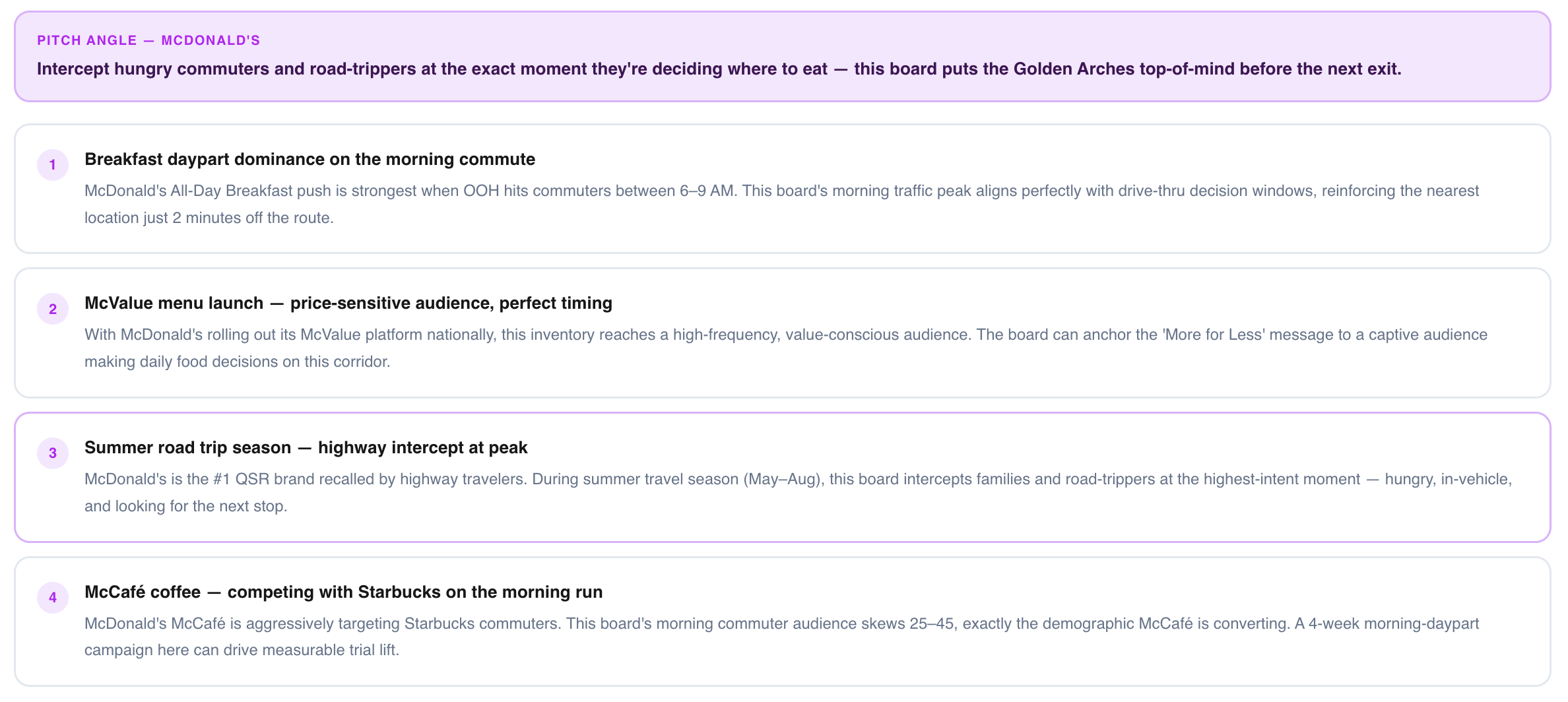
They type in the brand: McDonald's. The brand layer renders. The pitch angle is one sentence. Four story hooks tied to McDonald's current campaign cycle, their seasonal moments, their product launches, their geographic priorities. The rep picks one or two that resonate.
The rep places the call. They open with the brand-specific story — I noticed you've been pushing the breakfast bundle in the regional ads through Q2; we have a board on a corridor where 9,800 commuters pass three of your locations every morning, and the May-July inventory we have aligns with that push. They are seventy seconds into the call and the prospect is leaning in.
Ninety minutes of pre-call research has become ninety seconds of pre-call review. The rep made ten of those calls today instead of two. The pitches were sharper, not generic. The pipeline moves.
That is the rep's morning when Pitch Prep is in the stack. The photosheet you have in the folder is still there. Nobody's opened it in months. But what the photosheet was always trying to be — current, board-by-board, specific to the buyer in front of the rep — is finally what's on the screen every morning.
doohthis builds Pitch Prep — the three-layer pitch generation system that replaces the photosheet with board-level, vertical-level, and brand-level talking points generated fresh, every time, against live inputs. If your reps are still copying bullets out of a 2019 PDF, we should talk.